Article Contents
An unlucky pass while washing the bodywork, worst case, costs you the shine for a few days. An unlucky pass inside the engine bay can leave you with a car that won't start the next morning.
It isn't off-limits territory though. With a cold engine, proper covering and low pressure, it's completely fine, as long as you know what to watch for.
- The trick isn't water, it's patience: cold engine, proper covering, gentle pressure.
- What actually cleans is the chemical and the scrubbing, water just rinses it off at the end.
- The air intake doesn't forgive mistakes, more so than the connectors.
- On hybrids and EVs, orange cabling is a line you don't cross.
What You're Actually Risking
Pop the hood on any modern car and you'll see dozens of connectors, wiring, sensors, the fuse box, ignition coils, all crowded together. All of it is built to handle a rainy day on the road, not pressurised water from twenty centimetres away.
I'm not saying this to scare anyone. Manufacturers say it themselves in their owner's manuals: washing the engine bay with pressurised water can damage the electrical circuits. Even ADAC, Germany's biggest motoring organisation, advises against pointing a steam cleaner straight at it, exactly because electronics don't forgive that kind of treatment.
The worst part is timing. You won't notice a thing while you're washing. Moisture left sitting inside a connector works quietly over the following days, corroding the contact bit by bit, and by the time the fault actually shows up, nobody will think to connect it to a wash from a week earlier.
Why It's Worth the Effort
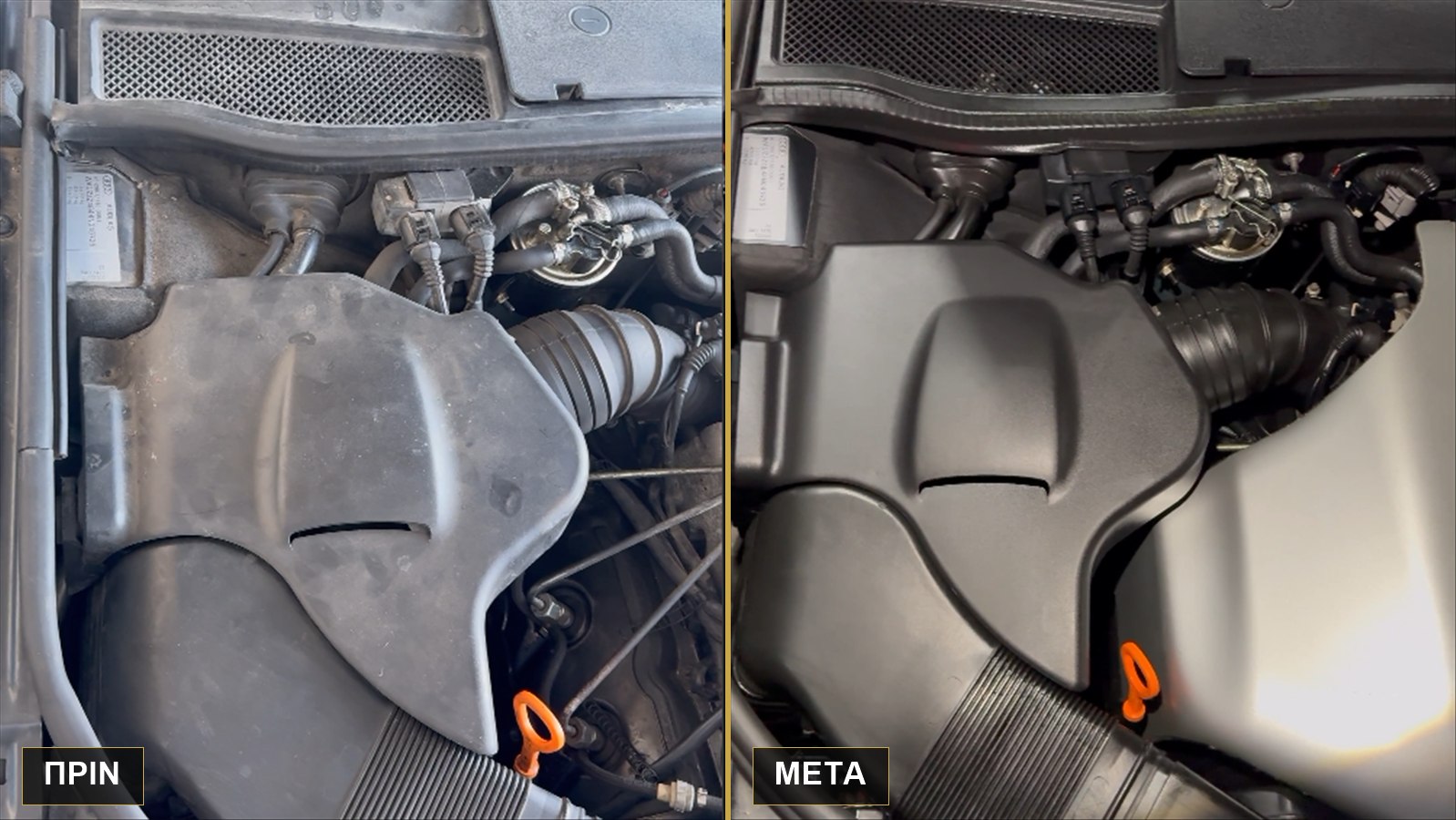
The first reason is purely practical: on a clean surface you spot an oil leak immediately, while on a valve cover caked in old grime you have no way of knowing if what you're looking at is fresh or leftover from the last service.
It matters for resale too, and in both directions. A buyer forms an opinion the moment they pop the hood, but on the flip side, a spotless engine bay doesn't necessarily mean a mechanically sound one, it just hides what it wants hidden better, so that's exactly where a careful eye pays off.
There's a reason few people think about: oil breaks down rubber over time. Hoses and mounts that stay constantly soaked age faster and eventually crack, and a drop of oil landing on a hot manifold will follow you into the cabin with its smell.
Getting Ready, Before You Get Anything Wet
Rule one: cold engine, shade, not straight after a drive. A sudden temperature drop on hot metal causes shock, and the first thing you'll feel is a cloud of steam in your face.
If you think about it, half the mess doesn't even need water. A brush and a bit of compressed air clear anything dry in seconds: leaves, twigs, dust, dirt. And the more that comes off this way, the less mud you'll be dealing with later.
- If the plastic engine cover comes off by hand, take it off first and wash it on its own.
- Anything that cleans dry with a brush or air doesn't need to get wet at all.
- Check the oil, coolant and brake fluid caps, they need to be screwed on tight before you continue.
- For extra peace of mind, disconnect the negative battery cable.
Then comes covering, and this is no place to cut corners. Anything that shouldn't take a single drop gets wrapped tightly in plastic or film and sealed with tape. That means the ignition coils and spark plug wells, which collect water like a little basin, every connector that's lost its rubber cap, the ECU where it's visible along with the fuse box and both battery terminals, the alternator which sits open by design for airflow, and the whole air intake system: the snorkel, the filter box, the mass airflow sensor.
That last one is in a different risk category entirely. If water gets in there, it doesn't just sit somewhere, the engine pulls it straight in the moment you turn the key. Most other mistakes are fixable. That one often isn't.
There's another trap with where the ECU sits: on plenty of models it isn't where you'd look first. On quite a few cars it's tucked away to the side of the engine bay, near the bulkhead, somewhere your eye doesn't naturally land. If you haven't confirmed exactly where it is on your own car, the safest move is to keep water away from that whole side.
How to Wash It Properly
What actually cleans is friction, not the force of the water. Plastic parts and wiring just need a soft brush or paintbrush, save anything stiffer for metal spots caked in oil. Spray goes on the brush first, never straight onto a connector.
Be especially careful with bare aluminium, a strong alkaline degreaser can permanently whiten it and strip its shine. Look for something neutral, dilute it properly, and test it first on a spot nobody will notice if it goes wrong.
On oily metal, the cleaner works better sprayed onto a dry surface. On plastic or painted parts it's the opposite, a light misting first helps the product avoid leaving a mark. Either way, give it a few minutes to work, it shouldn't dry on the surface before you rinse it off.
When you rinse, don't rush it. Work spot by spot with a gentle flow rather than a wide blast over the whole area, that way water doesn't pool anywhere. A plain garden hose actually does better here than a pressure washer, simply because it doesn't have the force to push water where it shouldn't go.
If all you've got at home is a pressure washer: use only the widest nozzle available and work from a distance, never up close, keeping the spray well away from connectors, coils, the alternator and the air intake.
Drying and the First Start
Ask anyone experienced and they'll tell you this is where it's actually decided whether you'll have a problem, and it's exactly the part most people skip. When you pull off the plastic covers, drag each one from a single edge in one direction, so any water sitting on top runs outward instead of into the components.
Next, go over the whole area with air, paying special attention to the spark plug wells and anything you had covered. Direction matters more than anything else here: come in at an angle around each connector, never straight on, because that only drives water in deeper instead of clearing it. A garden leaf blower works better than an air compressor if you have access to one, it gives you plenty of volume without the force that would need watching.
Whatever water is still visible comes off with a microfiber towel. Reconnect the battery if you'd disconnected it, and start the engine with the hood up, the heat from running will finish drying anything the air missed. The plastic cover is the last thing that goes back on, once everything's cooled down again, since on most models it sits right over the ignition.
Something stuttering at idle, or the engine light coming on and staying on? Don't push through it. Shut the engine off and give everything more time to dry before trying again. Chances are it's just moisture in a coil or connector, but a fault code that's already logged usually needs a diagnostic tool to clear for good.
What You Don't Touch, and When to Call a Professional
On a hybrid or electric model there's one absolute rule: anything marked in orange is a high-voltage circuit, and that means you don't wash it, touch it, or unplug it, full stop. That part belongs exclusively to a qualified technician, because a mistake there doesn't get a second chance.
Don't unplug connectors or sensors with the idea of washing underneath them, and don't reach for industrial solvents on plastic or rubber because they supposedly "work better". Hot pressurised water isn't any safer than cold, the problem is the pressure, not the temperature. One more thing that's easy to forget: no dressing spray goes anywhere near belts or pulleys, all it does there is make them slip.
There's no shame in admitting it and handing it over. If you don't have the right gear to dry it properly with air, if you're looking at parts you don't recognise, or if the grime is so heavy you don't know where to start, a shop will do it faster and safer than you will. The price difference over a simple exterior wash is small, nowhere near what you'd pay to fix damaged electronics.
Don't want to risk it yourself? We take care of engine bay cleaning, safely.