Article Contents
The circular swirl marks you see in your paint under sunlight almost never come from driving. They come almost entirely from the wrong washing technique, where trapped grit and dirt particles get dragged across the paint.
At HEX Detailing Garage in Trikala, we often see cars with paint worn down by brushes and the wrong sponges. The Two Bucket Method is the foundational technique for washing your car safely, while keeping any protection you have, whether that's ceramic coating or a protective film (PPF), completely intact.
- Swirl marks in your paint almost never come from the road; they come from washing it wrong.
- Two buckets with grit guards keep sand away from your wash mitt.
- Always work top to bottom, with straight strokes, never circular ones.
- If swirl marks are already there, only professional polishing removes them.
The Gear You Need
- 2 Wash Buckets (20L): One for the shampoo solution, the other reserved only for rinsing.
- 2 Grit Guards: Fitted into the bottom of each bucket. They trap heavy sand particles at the base, stopping them from circulating back into the water.
- Microfiber Wash Mitt: We avoid classic sponges entirely. The deep fibres of a microfiber mitt trap dirt inside themselves instead of pressing it into the paint.
- pH-Neutral Shampoo: A dedicated cleaner with no added waxes or gloss enhancers, so it doesn't strip the surface's hydrophobic properties.
- A Twisted-Loop Drying Towel or a Car Dryer.
The Step-by-Step Process
1. Touchless Pre-Wash
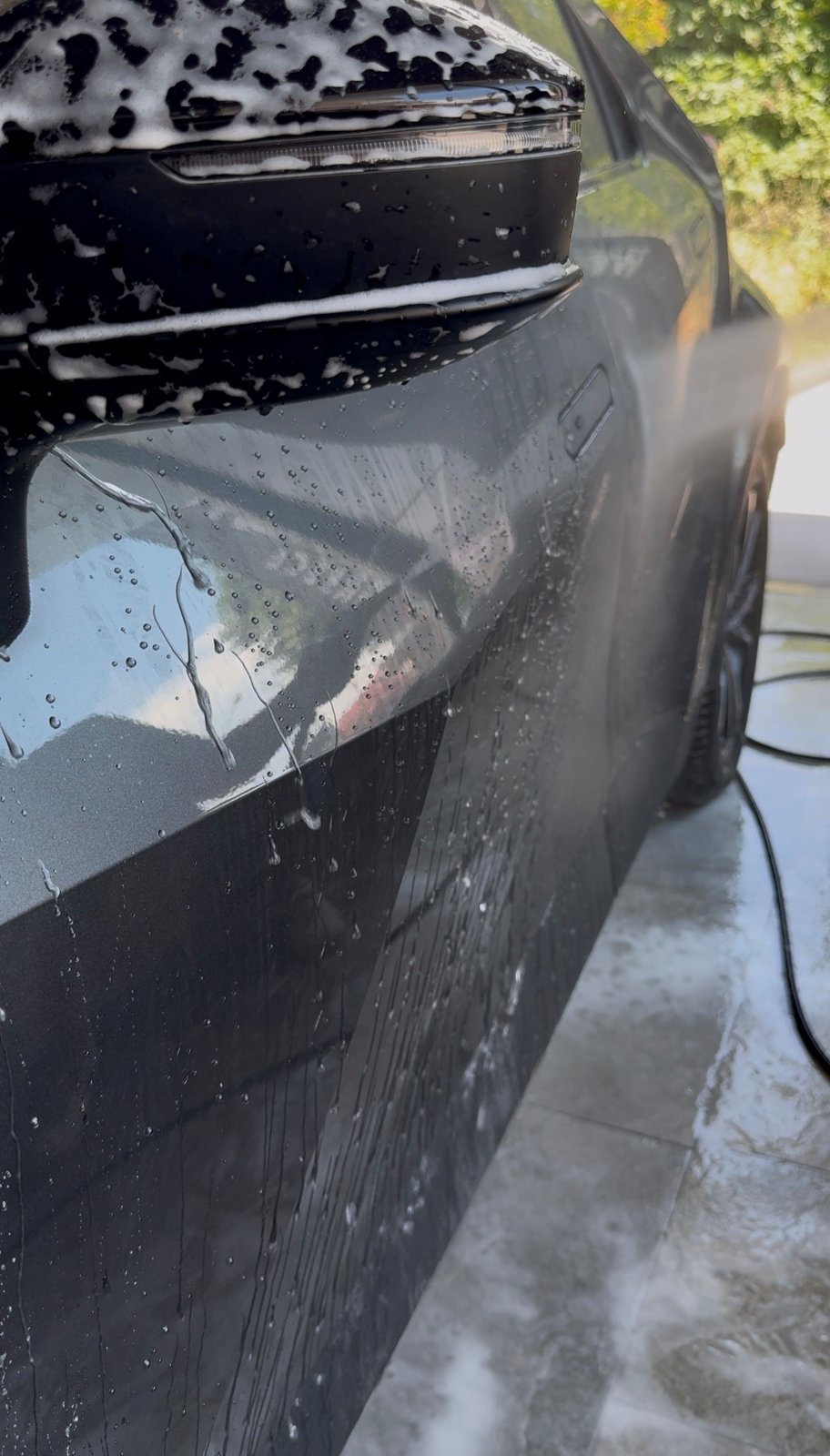
Before your mitt ever touches the bodywork, the heavy dirt needs to come off first. We apply an alkaline pre-wash with a foam cannon. The alkaline pH breaks down organic grime, insects and traffic film. We let the product dwell for a few minutes without letting it dry, then rinse it off with a pressure washer from the bottom up.
2. Preparing the Buckets
- Bucket 1 (Wash): Water with the recommended dose of pH-neutral shampoo.
- Bucket 2 (Rinse): Clean water only, nothing else.
Fit a grit guard into both buckets.
3. The Wash Technique
Dip the mitt into Bucket 1 (Wash) and always start from the top of the car (roof, pillars, bonnet) working down. The lowest panels, sills and bumpers, collect the most hazardous dirt and are always left for last.
Work strictly in straight, parallel strokes, never circular ones. If a grain of sand is caught under the mitt, a straight scratch is far easier to correct during polishing than a circular "spider web."
4. Rinse & Reload
After every panel (say, half the bonnet or one door):
- Dip the dirty mitt into Bucket 2 (Rinse).
- Work the fibres of the mitt lightly against the grit guard to release the trapped dirt to the bottom.
- Wring the mitt out over the bucket.
- Dip it back into Bucket 1 (Wash) for fresh suds, and keep going.
5. Safe Drying
To avoid drying-induced marring and water spots:
The best method is a car dryer, which blows water out of seams, mirrors and grilles without any contact at all.
If you use a twisted-loop microfiber towel instead, pat the surface dry rather than dragging the towel across it under pressure.
If your car's paint already has swirl marks, the Two Bucket Method will stop new ones from forming, but it can't undo the damage that's already there. That takes professional paint correction, with paint thickness measurement and dedicated polishing stages.
Want to see what a proper wash does for your car? Book an appointment.