Clicky

Paint correction and polishing for cars and motorcycles — HEX Detailing Garage Trikala
Scroll
Machine Polishing

Polishing /
Paint Correction.Trikala

Removal of swirl marks, scratches and oxidation with professional machine polishing. The paintwork returns to the depth and gloss it had when the car was new.

Paint Correction

What is Machine Polishing

Machine polishing is the professional removal of swirl marks, scratches and oxidation from the paint surface, restoring the deep gloss the car had when it was new.

Swirl Mark Removal
Eliminates the circular marks that create a hazy appearance under sunlight or artificial lighting.
Scratch Removal
Addresses surface-level scratches that haven't penetrated through to the primer layer.
Deep Gloss
Restores deep gloss and the wet-look effect that gives a showroom appearance.
Oxidation Removal
Removes the discolouration and haziness caused by prolonged UV exposure over time.
Prep for Coating
An essential step before ceramic coating to achieve maximum adhesion and results.
Resale Value
Significantly improves the appearance and market value of the vehicle.
Methodology

The methodologyHEX Paint CorrectionFrom measuring the paint to the final finish

At HEX, proper polishing doesn’t start by picking a compound and a pad. It starts by understanding the paint in front of us and assessing how much correction can be done safely.

Every car is different. The hardness of the clear coat, the type of paint system, the thickness and consistency of the readings, and the extent of the defects all directly affect the process we follow.

01

Deep Clean & Decontamination

Full exterior clean to remove dust, insects, tar and road grime. Iron fallout remover and clay bar treatment to fully decontaminate every surface. Any remaining contaminants can scratch the paint during polishing.

02

Paint thickness measurement with NexPTG

We take readings at many points across the body with a calibrated NexPTG paint thickness gauge.

We’re not interested in just one number. We assess the differences between readings, spot possible deviations and get a clearer picture of the paint’s condition and history.

The readings are an important assessment tool, but on their own they don’t reveal the full condition or the available correction margin. They are always combined with a visual inspection and a technical assessment.

03

Assessing paint type and hardness

Not all paints behave the same way. Different manufacturers and paint types can differ significantly in hardness and in how they respond to machine correction.

We assess whether the paint is a single-stage or two-stage system, as well as the characteristics of the clear coat, where there is one. For example, many German paints are harder, though this isn’t an absolute rule.

These differences decide how aggressive or gentle the approach needs to be.

04

Masking

Covering rubber, plastic and chrome trim that won't be polished. Masking protects adjacent components and allows precise work close to panel edges.

05

Test spot · We test first, then decide

Before moving on to the whole car, we do a test spot.

We choose a combination of machine, pad and compound based on the paint and the result we want to achieve. In more demanding cases, a rotary polisher with a wool pad or a 21mm dual-action polisher with a microfiber cutting pad may be used.

We then assess the real result: how effectively defects and scratches are removed and what level of correction we can achieve.

Based on that result, we agree the goal of the job with the owner, taking into account the condition of the paint, the desired result and the available budget.

06

Paint correction and checking the result

The cutting stage aims to correct the defects that have been agreed. The more aggressive combinations can leave behind holograms from a rotary polisher, or DA haze from a dual-action polisher with an aggressive pad.

This doesn’t necessarily mean the process has failed. It’s a possible result of an aggressive correction stage, which is followed by a suitable finishing stage.

To refine the final look we can, for example, use a 15mm dual-action polisher with a medium pad and a medium-cut compound, always adapting the combination to the specific paint.

During the work we also monitor the surface temperature, adjusting the pace and process to avoid excessive heat stress.
07

The final finish

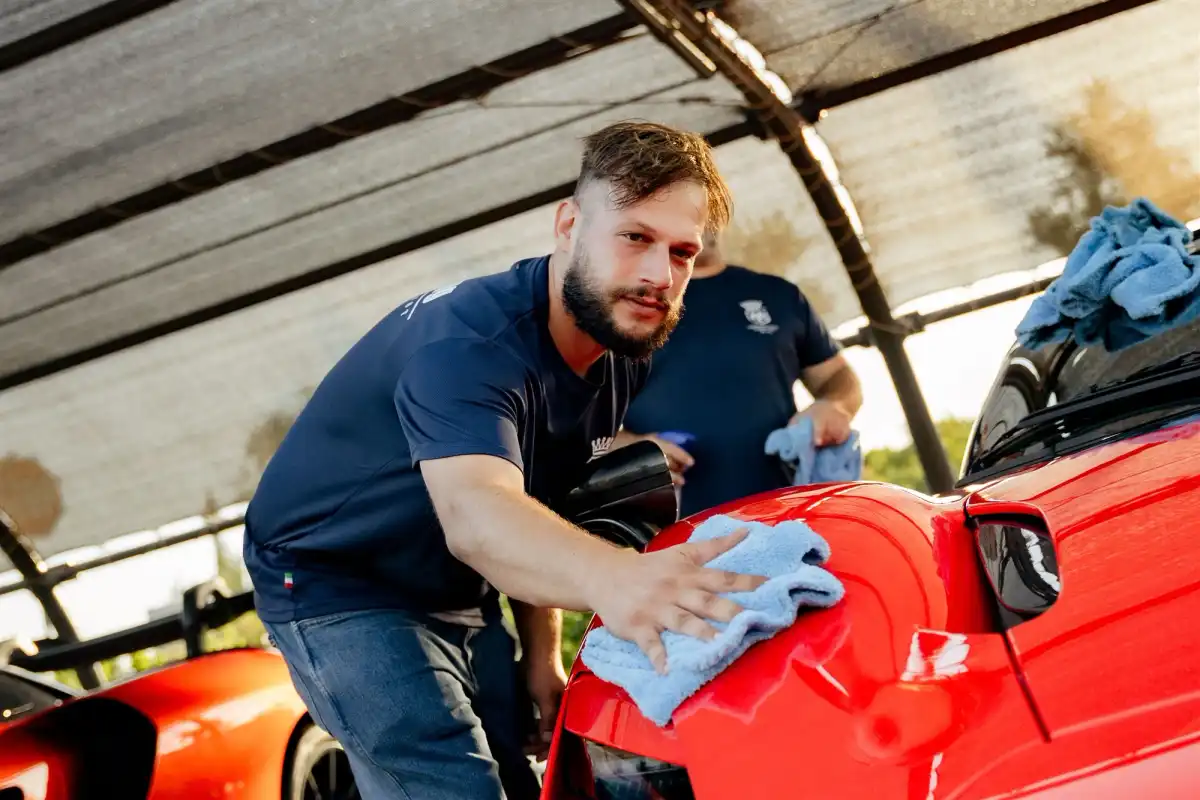
Our goal isn’t simply to remove as many scratches as possible. It’s to achieve the best possible visual result while managing the paint responsibly.

That’s why each stage is assessed separately and the final approach is adapted to what each car can realistically take.

08

IPA Wipe & Final Inspection

Panel wipe-down with IPA to remove polishing oils and reveal the true result. Final inspection under specialist lighting to confirm no remaining defects.

09

Surface Protection

Application of wax, paint sealant, ceramic coating or polyurethane protective film (PPF) to preserve the result. Without protection, the freshly corrected surface is immediately exposed to environmental damage. Ideally combined with ceramic coating for long-lasting results.

At HEX we don’t apply the same recipe to every paint. We measure, assess, test and choose the process based on the data of the specific car.

Visual Protection Comparison

How much does your paint really change?

Move the lens over the surface, run a water test and see how hydrophobicity and durability change with the level of care — from a simple wash to a full protective film.

Hydrophobicity
Gloss
Durability

Drag the lens over the paint

Values are indicative, for illustrative purposes only, and are not based on laboratory measurement of a specific vehicle. © 2026 HEX Detailing Garage.

For maximum protection after paint correction, consider ceramic coating — protection 4+ years →

Contact

Book an Appointment

Send us your request and we'll get back to you to discuss availability and provide an accurate quote.

★★★★★ · 60+ customers trust us — We reply within 24 hours.

★★★★★ 5.0 · 64 Google reviews View reviews →

By submitting you agree to our Privacy Policy.

After submitting, we'll contact you to assess your vehicle's condition and provide an accurate cost estimate.

Hours
Monday–Friday :09:00–17:00Saturday :09:00–15:00
FAQ

Frequently Asked Questions about Paint Correction

Everything you want to know about paint correction.

Paint correction is the process of removing scratches, swirl marks and surface imperfections from a car's paintwork using a machine polisher and abrasive compounds. The result is a flat, glossy surface free of reflective defects.

It depends on the severity of the defects: 1-Step for light swirl marks, 2-Step for deeper scratches, 3-Step for heavy oxidation and serious paint damage. During the visit we assess which level your vehicle requires.

Not necessarily. Some scratches are very deep, and trying to remove them completely could mean removing too much material from the paint. In those cases we assess what can be corrected safely and tell the owner what result is realistic before we go ahead.

Permanently — paint correction does not fade. What may affect the result is new scratches from improper washing or impacts. To preserve the surface, a ceramic coating or paint sealant immediately after is strongly recommended.

Not mandatory, but highly recommended. After paint correction the surface is open and unprotected. A ceramic coating applied immediately after seals the paint and protects it for 4+ years.

Measuring with a calibrated NexPTG gauge helps us assess the coating thickness at different points across the body and spot possible deviations. That gives us more data before deciding how aggressive the correction process can be. The readings don’t replace the visual and technical inspection, but they are an important part of the assessment.

Paint hardness and type vary from car to car. A harder paint may need a different combination of machine, pad and compound than a softer one. Age, previous care and the extent of the defects also play a part.

A test spot is a trial application on a small area of the car. It lets us check in practice which combination of compound, pad and machine gives the best balance between cutting and final finish. That way we don’t choose the process by chance, or automatically apply the same technique to the whole vehicle.

The more aggressive correction techniques aim to remove significant defects. Depending on the machine and pad, they can leave holograms from a rotary polisher or DA haze from a dual-action polisher. These are possible marks of the cutting stage, and they are dealt with by a suitable finishing stage.

No. The choice depends on the hardness and type of the paint, its thickness and condition, and the desired result. We have different machines, pads and compounds so we can adapt the process to each vehicle’s needs.

It depends on the correction level (1-Step, 2-Step, 3-Step), the size and type of the vehicle. Contact us for a free, no-obligation estimate.

Viber