Article Contents
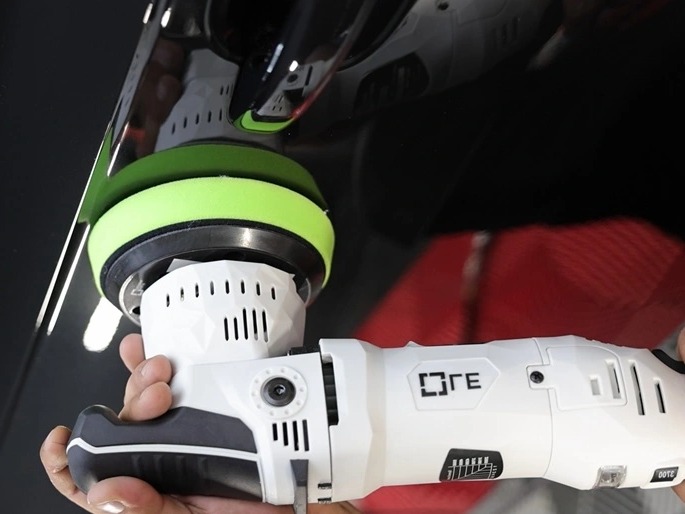
Before the polisher touches your car, we go over the whole body with a paint thickness gauge. It takes a few minutes. Those few minutes decide whether the polish takes out the swirl marks or leaves a door with no clear coat.
- Factory paint is about 90 to 140 μm in total, and the clear coat only 35 to 50 μm. Every polish takes a little of it off.
- We measure every panel in several spots with a NexPTG gauge and build a map of the car.
- Before every job we check the gauge on its reference plates.
- The readings decide how we work each panel, and we tell you up front what can come out and what can't.
1. The Paint Is Thinner Than You Think
Factory paint has a total thickness of roughly 90 to 140 μm, that is, thousandths of a millimetre. A sheet of A4 paper is about the same. Of that, the clear coat (the transparent layer we polish) is usually 35 to 50 μm.
Every polish removes a little of that clear coat. A little, but it counts. A cutting step with compound can take a few μm in one pass. If the clear coat has already been worn down by earlier polishing, the margin shrinks fast. That's why, before we start, we ask one question: how much can we take off without the car paying for it?
2. What the Gauge Tells Us
We work with a NexPTG gauge. It measures in a second and tells by itself whether it's on steel or aluminium. That matters, because many cars have an aluminium bonnet or wings.
We measure each panel in several spots, not once in the middle. At the end we have a map of the car and we know:
- which panels have even, factory paint
- which have been resprayed or have filler
- where the paint is already thin and needs care
One thing to be clear about: the gauge shows the total thickness, not just the clear coat. That's why we read the measurements against each other. If the roof reads 120 μm and one spot on the bonnet 85, something has happened there, and usually that something is called "a previous polish".
3. Calibration: First We Check the Gauge Itself
A 10 μm error in the gauge doesn't sound like much. On a 40 μm clear coat, though, it's a quarter of it.
So before every job, we check the gauge on its reference plates. If it doesn't read what it should, we don't measure anything on your car. A simple step, but many people skip it.
Want to know what shape your paint is in? Book a polish and you'll see the readings before we start.
4. From the Number to the Decision
We don't measure to write numbers on a sheet of paper. The readings change how we work each panel. The values below are a rough guide and vary from manufacturer to manufacturer.
| Reading (μm) | What it usually means | How we proceed |
|---|---|---|
| Below 80 | Thin paint, probably polished before | Only a light finishing polish, or no polishing at all |
| 80 to 160 | Factory range | Normal correction, after a test spot |
| 160 to 250 | Possibly a touch-up or a second coat of paint | Test first, because the clear coat behaves differently |
| Above 250 | Resprayed panel, possibly with filler | Carefully, often finishing polish only |
There's one thing the table doesn't show: the edges and body lines. The paint there is almost always thinner and heats up faster under the polisher. That's where we take the most care: we get as close as each car allows, but we never work on them.
5. What It Means for You
- You know from the start what can come out and what can't. If a scratch can't be removed safely, we tell you before, not after.
- We don't eat into clear coat you'll need for a future paint correction.
- If you bought the car used, you find out which panels have been resprayed. Some people hear it for the first time from us.
Anyone who polishes without measuring is just guessing. At HEX we always start with the gauge, and if you like, we'll show you the readings right there, next to the car.
FAQ
Can a car with resprayed panels be polished?
Yes, but more carefully. The clear coat on a resprayed panel behaves differently from factory clear, so we do a test spot first and often stick to a finishing polish.
What if the paint is already thin?
Then we only give that panel a light finishing polish, or leave it unpolished. If a scratch can't be removed safely, we tell you before we start.
Can I see my car's readings?
Yes. If you like, we'll show them to you right there, next to the car, before we start polishing.